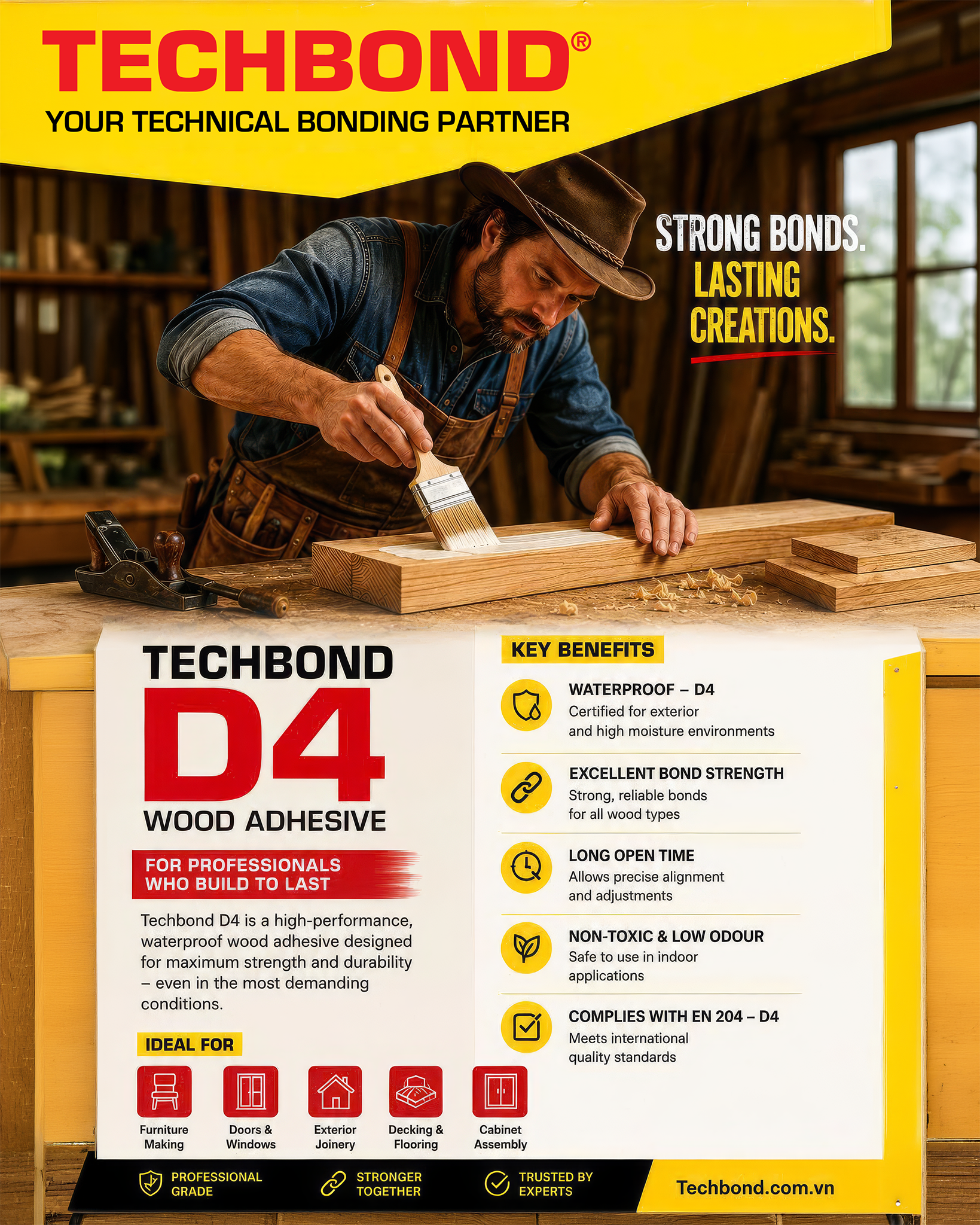
TECHBOND D4 adhesive is classified as D4 under EN 204 for thermoplastic wood adhesives used in non-structural applications. D4 is the highest level in the D1–D4 classification and is intended for indoor joints exposed to running water or condensation for extended periods, as well as certain outdoor applications when a suitable protective coating is used.
In furniture and woodworking production, the D4 classification is important when a bonded joint must work in humid conditions or come into contact with water. However, the D4 label alone does not mean that one adhesive is suitable for every wood species, product or production line.
Table of Contents
What is the EN 204 standard?
EN 204 is a European standard for classifying thermoplastic wood adhesives used in non-structural applications. It divides adhesives into four durability classes, D1 to D4, based on the strength of bonded joints in dry and wet conditions after specified test cycles. The related test method is EN 205:2016.
EN 204 does not evaluate the heat resistance of a joint and is not a standard for load-bearing timber structures. EN 204:2016 is the issued standard; any newer proposal should be checked against the current technical documentation before use.
What does D4 mean under EN 204?
D4 is the highest durability class in the EN 204 system. It describes bonded joints for indoor use with frequent, long-term exposure to running water or condensation. For outdoor use, the surface should be protected with an appropriate coating.
In simple terms, D4 indicates that a joint has achieved the required performance in EN 204 testing under defined conditions. It does not mean that the adhesive is completely waterproof in every application. Actual performance depends on the materials, joint design, production process and surface protection.
The TECHBOND 2026 catalogue lists water-based adhesive solutions for D4 applications in the woodworking industry. Product codes, specifications and uses must be checked against the current TDS before production. See TECHBOND woodworking adhesive solutions.
Why should you not choose an adhesive based only on the D4 label?
A suitable bonding solution must meet the complete production conditions, not only the D4 classification. Key factors include:
- Wood, board or other materials to be bonded.
- Condition and characteristics of the bonding surfaces.
- Joint design and production step.
- Equipment, application method and production speed.
- Expected service conditions of the finished product.
- Internal quality-control requirements.
In addition to asking whether an adhesive is D4-rated, businesses should ask whether it is suitable for their materials, process and joint requirements.
When should you contact TECHBOND about TECHBOND D4?
Contact TECHBOND when developing a new product, changing materials, adjusting a process or reviewing an existing bonding solution. You may also discuss requirements such as higher hardness, faster drying or a specific colour. Our technical team evaluates the application and process before recommending a suitable solution.
What information should you prepare for a technical consultation?
- Materials: material name, construction, surface condition and any relevant layers.
- Process and joint type: adhesive location, contact surfaces and the role of the joint.
- Equipment and current process: equipment type, adhesive application method and key process steps.
- Production conditions: production rate, working environment and problems to improve.
- Finished-product requirements: expected service environment, inspection criteria and applicable standards.
The clearer the input information, the more focused the technical discussion. Product suitability should be confirmed through the current TDS and appropriate technical evaluation.
Frequently asked questions about TECHBOND D4 adhesive
Can TECHBOND D4 be used for every type of wood?
No. Suitability must be evaluated according to the material, surface, joint design, process and finished-product requirements.
How is D4 different from D1, D2 and D3?
EN 204 defines four durability classes, D1–D4. Higher classes describe more demanding moisture and water exposure. D4 is the highest class, but product selection must still be based on the application and the adhesive TDS.
Is TECHBOND D4 completely waterproof?
No. D4 confirms performance in the specified EN 204 tests. It does not guarantee suitability for every immersion condition, outdoor environment or product design.
Is the material name alone enough to select an adhesive?
No. The technical team also needs to understand the process, equipment, production conditions and joint requirements.
Talk to the TECHBOND technical team
If you are evaluating TECHBOND D4 adhesive, prepare information about the materials, process, equipment and joint requirements. Contact TECHBOND for technical advice or an application-based quotation.
References for EN 204
Related articles: Explore TECHBOND woodworking adhesives, compare the TECHBOND industrial adhesive product range, and contact the TECHBOND R&D Centre for guidance on D4 bonding applications.
Need advice on the right industrial adhesive?
Share your materials, application and production process. TECHBOND will help recommend a suitable solution.
Request a consultation