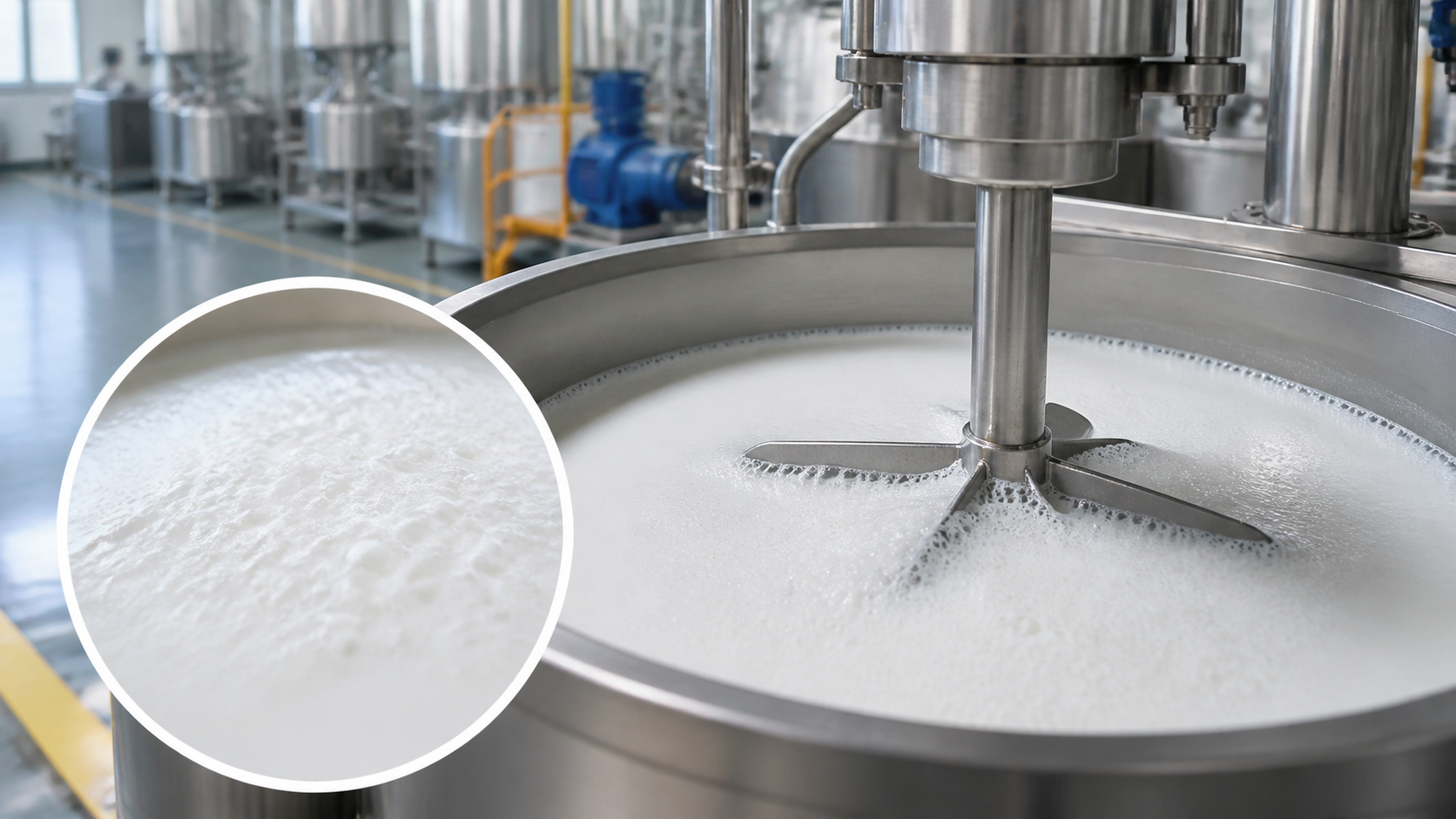
Water-based adhesive foaming occurs when air is entrained during mixing, pumping, filling or application. Persistent foam can create pinholes, uneven glue lines, material waste and weaker adhesion after drying.
Nội dung bài viết
What causes water-based adhesive to foam?
Surfactants and dispersed polymers can stabilize foam in water-based systems. Excessive agitation, deep vortexing, low tank level, pump cavitation, leaking suction lines, blocked filters and undersized pipes may all draw air into the adhesive. Formula changes, additives, temperature fluctuations, freezing, overheating or contamination can also reduce foam stability.
Five common causes
- Over-agitation: high mixer speed or a deep vortex entrains air.
- Pump and piping: valves, fittings, filters and suction lines create turbulence or air leaks.
- Formula or additive changes: surfactants, wetting agents and viscosity modifiers affect foam behavior.
- Improper temperature or storage: freezing, overheating and contamination destabilize the dispersion.
- Application conditions: rollers, brushes, spray heads or excessive pressure may generate foam.
How to troubleshoot foaming
1. Identify when foam appears
Record whether foam forms during mixing, pumping, filling, application or drying. This helps separate equipment, process and formulation causes.
2. Compare adhesive condition
Check color, viscosity, odor, homogeneity and the time required for foam to disappear before and after mixing. Test on the actual substrate under production-like conditions.
3. Inspect equipment
Check mixer blades, speed, pump, valves, filters, pipes and every point that may admit air. Trial a lower mixing speed or a submerged return line while documenting each change.
4. Test defoamer carefully
Choose a defoamer compatible with the polymer, viscosity, application method and surface requirements. Determine dosage through controlled trials; one fixed ratio is not suitable for every adhesive.
Ways to reduce foam
- Reduce mixing speed and avoid deep vortexing.
- Keep the adhesive return line below the liquid surface.
- Check pump suction leaks and clean filters and nozzles.
- Control pump speed and dispensing pressure.
- Evaluate adhesion, drying time and appearance after each adjustment.
When should you change the adhesive?
Consider a different formulation only after equipment and process checks are complete, especially if foam persists, defoamer reduces bond strength, or the adhesive does not match the line speed or coated substrate. For water-based adhesive applications in paper and packaging, see TECHBOND’s paper and packaging adhesives range.
Frequently asked questions
Does foaming mean the adhesive is spoiled?
Not necessarily. Foam may come from mixing, pumping or application. If color, odor, viscosity or uniformity changes, stop using the batch and consult the supplier.
Should water be added to reduce foam?
No. Uncontrolled dilution changes viscosity, solids, drying time and adhesion.
Can one defoamer be used for every water-based adhesive?
No. Compatibility must be confirmed with the specific formulation and application.
Conclusion
Water-based adhesive foaming can originate from formulation, equipment, storage or application. The reliable solution is to identify when foam starts, inspect the process systematically and validate any defoamer or process change with production-relevant tests.
TECHBOND MFG (Vietnam) Co., Ltd.
Hotline: 0866 15 37 68
Email: info@techbond.com.vn

Need advice on the right industrial adhesive?
Share your materials, application and production process. TECHBOND will help recommend a suitable solution.
Request a consultation