
Can you mix two hot melt adhesives? In routine production, do not blend different adhesive grades in the melt tank unless the manufacturers have confirmed compatibility and a controlled trial has validated the mixture. Similar-looking pellets can have different polymers, tackifiers, waxes and stabilizers. An untested blend may change application behavior, bond quality and equipment cleanliness.
Nội dung bài viết
What is a hot melt adhesive?
A conventional hot melt adhesive is commonly supplied as pellets, blocks or other solid forms. It is heated for application and develops initial strength as it cools. A formulation may contain a base polymer, tackifier, wax and stabilizers selected for a particular substrate and process.
- Base polymer: influences the adhesive’s flow, flexibility and bond behavior.
- Other ingredients: can adjust tack, viscosity, open time, set time and thermal stability.
Reactive PUR hot melts also cure through moisture after application, so their handling and storage requirements differ from those of many conventional thermoplastic grades.
Common hot melt adhesive categories
Adhesives can be grouped by chemistry or application, but a category name does not define a complete formulation. Examples include EVA-based grades, polyolefin-based grades, pressure-sensitive hot melts and reactive polyurethane (PUR) hot melts.
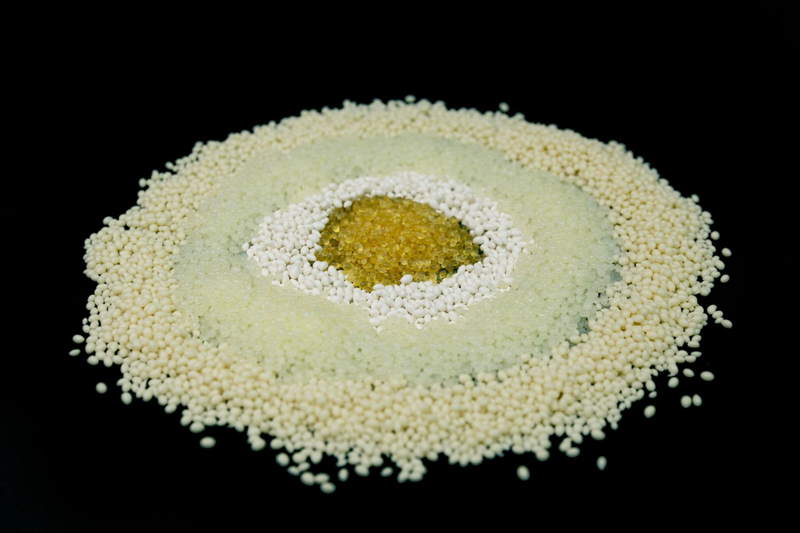
Check the exact adhesive grades before changing material in a melt tank.
- EVA-based hot melts: widely used in selected paper, carton and woodworking processes, with performance varying by grade.
- Pressure-sensitive hot melts: formulated to remain tacky for applications such as labels or tapes.
- Polyolefin-based hot melts: used for suitable substrates and processing conditions; moisture performance must be verified by grade.
- Reactive PUR hot melts: gain initial strength as they cool and subsequently moisture-cure; they require compatible equipment and handling procedures.
Use our technical specifications guide to compare the data for two candidate grades.
Can you mix two hot melt adhesives in one tank?
The question “can you mix two hot melt adhesives?” calls for a cautious production rule: avoid it without written supplier guidance and validation. Even two EVA-based products may use different additives, application-temperature ranges and target substrates. The same base-polymer label is not proof that a blend will remain stable or perform as intended.
1. Compatibility is uncertain
Two formulations may separate, form deposits or produce an inconsistent melt. Their combined viscosity, open time and bond strength cannot be predicted from appearance alone. Unsupported claims that every mixed pair will generate hazardous gas are also inappropriate; assess any safety concern using the specific products’ safety data sheets and supplier instructions.
2. The applicator may become difficult to maintain
A change in melt flow or thermal stability may leave residue in the tank, filter, hose or nozzle. Material left at an unsuitable temperature can form char and contribute to blockages. If a line begins to clog after a changeover, check the material and cleaning history as well as equipment settings. See our guide to preventing hot melt adhesive nozzle clogs.
3. Bond performance may change
One grade may be formulated for rapid setting and another for a longer open time. A mixture may not meet either specification. It can alter wetting, bead shape, compression needs and finished bond strength. This risk matters even when both original grades perform well on their own.
4. Application settings become unclear
Each grade has its own recommended processing range. For example, combining grades with different temperature ranges does not create a new validated setpoint. Excessive heat or long residence time may degrade one component; too little heat may prevent another from flowing properly. Review our application-temperature guide before changing settings.
5. Cleanup and traceability become harder
An unidentified mixture makes it difficult to trace a bonding defect to a batch or formulation. PUR products deserve particular care because uncured adhesive can react with atmospheric moisture inside equipment. Follow the supplier’s approved purge and cleaning procedure during a grade change.
What determines whether a controlled blend is possible?
To answer “can you mix two hot melt adhesives?”, assess the exact grades and equipment, not merely broad families such as EVA or polyolefin. Ask both suppliers whether blending is permitted, and define the intended mix ratio, application conditions and performance tests before any production use.
- Product identity: record the full grade name, batch and technical data for each material.
- Ratio and process: specify how the materials would be measured and mixed; an arbitrary ratio is not a validated formulation.
- Equipment: confirm the applicator’s permitted materials, temperatures and cleaning method.
- End-use testing: inspect melt stability, glue pattern, initial bond and aged bond under the actual service conditions.
Recommendation: For a routine grade change, plan to use one suitable adhesive and follow the manufacturer’s tank emptying or purge instructions. If no single grade meets the requirement, discuss a supplier-developed formulation or a controlled trial before putting any blend on the production line.
If your team asks “can you mix two hot melt adhesives?” for a specific job, send TECHBOND the product grade names, machine model, substrate and process conditions for advice.
TECHBOND MFG (VIETNAM) CO., LTD.
- Address: No. 18 VSIP II-A, Street 23, Vietnam–Singapore Industrial Park II-A, Vinh Tan Ward, Tan Uyen City, Binh Duong Province, Vietnam
- Hotline: 0866 15 37 68
- Email: info@techbond.com.vn

TECHBOND Vietnam is a leading manufacturer of industrial adhesives in Vietnam. We specialize in providing a wide range of flexibly customized adhesive products to meet the diverse requirements of our customers.
Need advice on the right industrial adhesive?
Share your materials, application and production process. TECHBOND will help recommend a suitable solution.
Request a consultation







