Water-based adhesive foaming occurs when air is entrained in the adhesive, creating visible foam or microbubbles during mixing, pumping, filling, or application. If the foam remains, the glue line may become porous, uneven, or have reduced adhesion after drying.
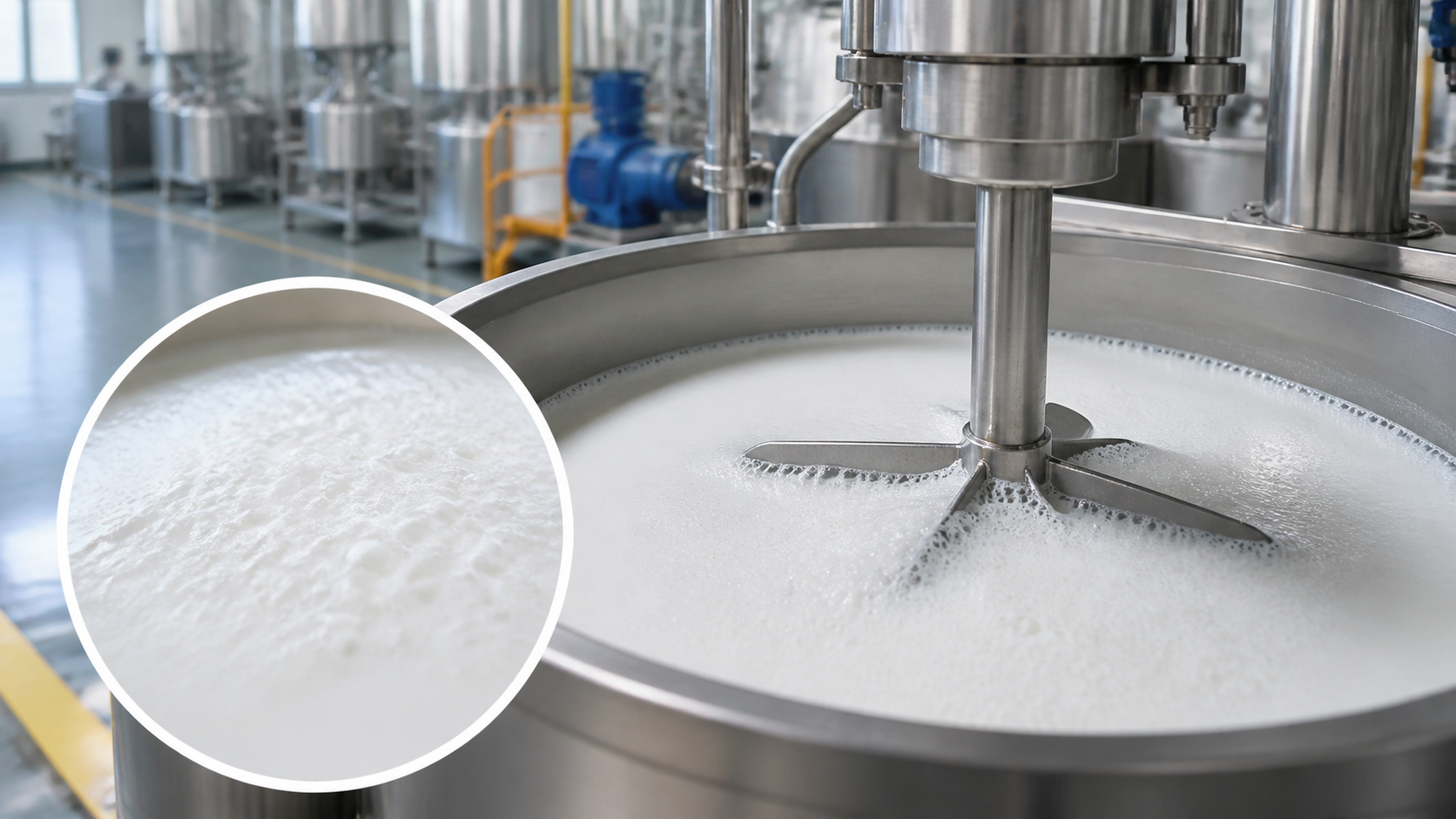
Table of Contents
What is water-based adhesive foaming?
In water-based adhesive systems, surfactants and dispersed polymers can stabilize foam. Mechanical action from high-speed mixing, pumping, or application equipment may introduce air into the system. Persistent foam can cause an uneven adhesive surface, porous glue lines, material waste, and production interruptions.
5 common causes of adhesive foam
1. Excessive mixing or air entrainment
High agitator speed, a deep vortex, or an insufficient adhesive level in the tank can draw air into the adhesive.
2. Pumps and piping generating foam
Valves, fittings, filters, suction lines, and pumps can create turbulent zones. If foam increases after pumping, check for air leakage on the suction side, blocked filters, and undersized piping.
3. Formula or additive changes
Surfactants, wetting agents, viscosity modifiers, and other raw materials can affect foam stability. Do not increase defoamer dosage without checking compatibility with the adhesive formulation.
4. Improper temperature or storage
Temperature fluctuations, freezing, overheating, or contamination can affect dispersion stability. Store the adhesive according to the product TDS and SDS.
5. Foaming during application
Rollers, brushes, spray heads, or adhesive gaps may generate foam when application speed is too high, pressure is unstable, the substrate is dusty, or the applied amount is excessive.
How to identify the cause
Step 1: Identify when the foam appears
Record whether foam appears during mixing, pumping, filling, application, or drying. This helps separate formulation, equipment, and process-related causes.
Step 2: Check appearance and stability
Compare the adhesive before and after mixing. Check color, viscosity, odor, uniformity, and the time required for foam to disappear. Test on the actual material under production-like conditions.
Step 3: Inspect the equipment
Check the agitator, mixing speed, pump, valves, filters, piping, and possible air-entry points. Test one adjustment at a time and record the result.
Step 4: Test a compatible defoamer
A defoamer must be compatible with the polymer system, viscosity, application method, and surface requirements. Determine the dosage through controlled trials rather than applying one fixed ratio to every adhesive.
How to reduce foam during production
- Reduce mixing speed when foam is caused by air entrainment.
- Avoid a deep vortex around the agitator.
- Keep the adhesive return line below the liquid surface.
- Check the pump suction line for air leaks.
- Clean filters and application nozzles.
- Control pump speed and adhesive pressure.
- Test defoamer at several low dosages.
- Recheck adhesion, drying time, and surface appearance after each change.
When should you change the adhesive?
Consider changing the adhesive when foam persists despite stable equipment, the defoamer reduces adhesion, the adhesive does not match the production speed, or the substrate has a coating or absorption level different from the original design.
Adhesive selection should consider the materials, coating method, production speed, coat weight, drying conditions, and final-use requirements.
Frequently asked questions
Does foaming mean the adhesive is damaged?
Not necessarily. Foam can result from mixing, pumping, piping, or application. If the adhesive changes color, odor, viscosity, or fails to return to a uniform state, stop using it and consult the supplier.
Should water be added to reduce foam?
Do not add water without technical approval. It can change viscosity, solids content, drying time, and adhesion.
Can one defoamer be used for every water-based adhesive?
No. The defoamer must be tested with the specific formulation and application before mass production.
Related articles
- Water-Based Adhesive: Composition, Key Benefits and Practical Applications
- TECHBOND industrial adhesive solutions
Conclusion
Water-based adhesive foaming may come from the formulation, equipment, piping, storage, or application method. The most effective approach is to identify when the foam appears, check each possible factor, and run controlled trials before applying a change to full-scale production.
Are you experiencing water-based adhesive foaming on your production line? Share your materials, equipment, and process details with TECHBOND for technical evaluation and a suitable solution.
Troubleshooting checklist for production teams
Start with a small sample and compare the adhesive before and after each process step. If the adhesive becomes foamy after agitation, review the agitator speed, vortex depth, batch level, and mixing time. If foam appears after transfer, inspect the pump suction line, seals, filters, valves, and return line for air leaks or excessive turbulence.
For application-related foam, check the roller, brush, spray head, nozzle, pressure, line speed, and substrate condition. Record the substrate, coat weight, open time, drying temperature, and final bond result for every trial.
Do not evaluate a defoamer only by how quickly it breaks visible foam. Also check wetting, surface appearance, adhesion, drying, blocking, and long-term stability. A defoamer that removes foam but weakens the bond is not a suitable production solution.
Production control recommendations
- Keep a batch record for raw materials, temperature, viscosity, mixing speed, and mixing time.
- Use consistent filling levels to reduce air entrainment.
- Maintain filters, pumps, valves, and hoses on a preventive maintenance schedule.
- Keep adhesive return lines below the liquid surface whenever possible.
- Quarantine abnormal batches until viscosity, drying, and adhesion are checked.
- Approve formulation or defoamer changes with a controlled trial before full-scale production.
These controls help distinguish a formulation problem from a process problem and make corrective actions repeatable across production batches.
Related articles: Explore the TECHBOND industrial adhesive product range, learn more about paper and packaging adhesives, and contact TECHBOND for technical guidance on water-based adhesive processes.

Need advice on the right industrial adhesive?
Share your materials, application and production process. TECHBOND will help recommend a suitable solution.
Request a consultation